
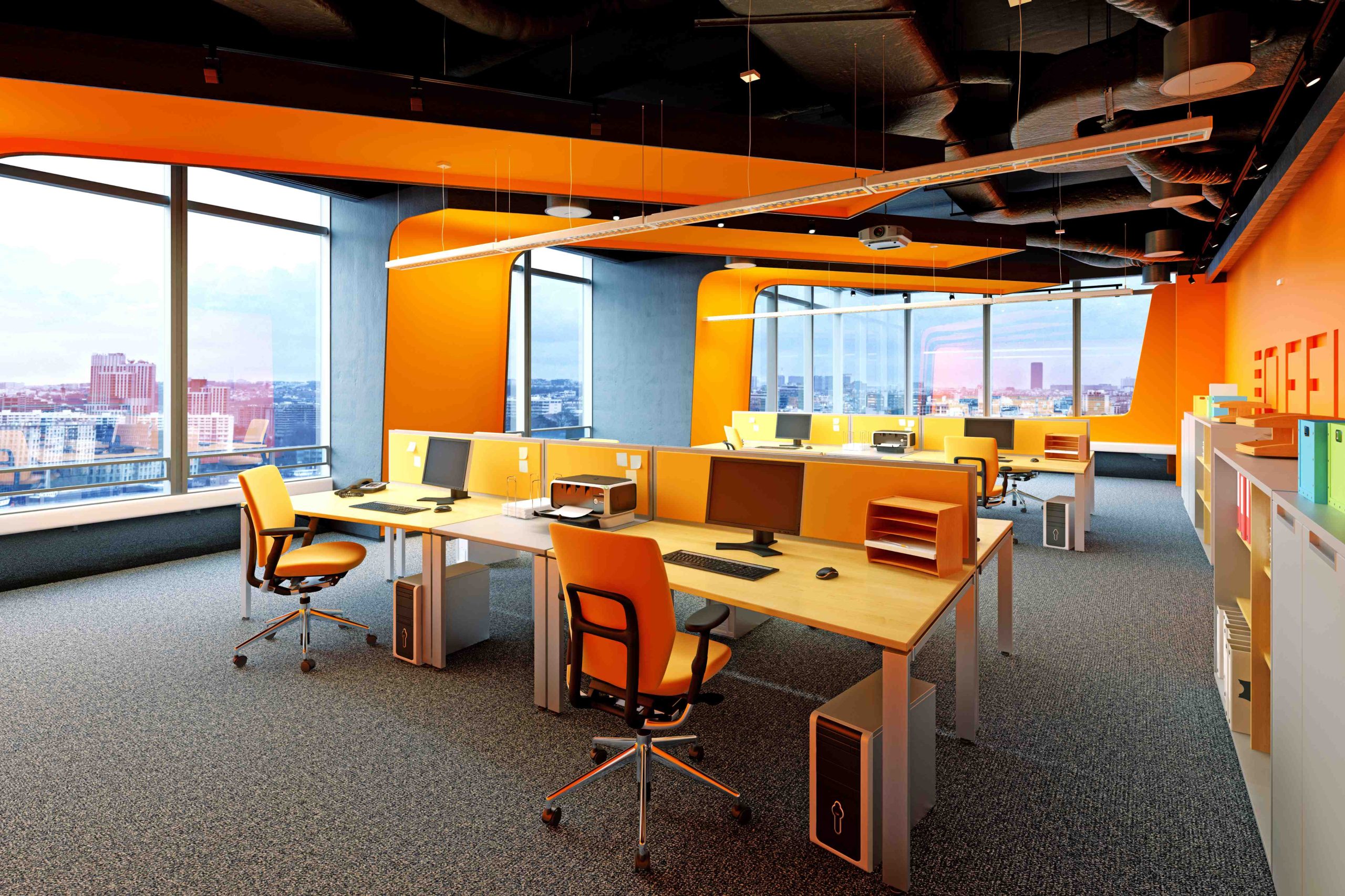
Throughout history, people have argued whether or not colours can influence our mood, productivity, and psychological well-being. Numerous studies have found that colours have a profound effect on people’s emotions. In 1979, a study on American prisons found that painting the walls pink reduced aggressive behaviour among inmates. Although offices shouldn’t be compared to jails or prisons, this study does demonstrate the power of colour.
The influence of colour has been the subject of a lot of research. According to studies conducted by the Department of Environmental Psychology at Lund University in Sweden, colour has a significant impact on our brain impulses and, as a result, can significantly affect our behaviour and well-being.
You might be surprised by the effect an office’s colour scheme has on its staff. In this article, we’ll discuss why it’s time to introduce some colour into the all-white and all-grey workplace.
Blue for stimulating the mind, leading to better productivity and efficiency
A room painted blue is particularly advantageous for people with demanding jobs. This is due to the fact that blue is a calming colour that reduces stress and does not interfere with mental focus.
Blue stimulates the mind, increasing mental activity and productivity. Blue colour shades are excellent for maintaining concentration in repetitive industries. Blue paint is frequently used in accounting offices to boost output and maintain staff focus.
However, it’s crucial to use blue strategically in the workplace because some people find some blue hues to be a little depressing and sad. A blue colour that is too “cold” may make the office feel less welcoming. Employee comfort may suffer as a result, which will reduce productivity.
Tip: Test the colour in your actual office space under both natural and artificial lighting to make sure the blue shade is the right one.
Yellow for evoking positive emotions and workplace creativity
According to Lee Chambers, an environmental psychologist and well-being consultant, yellow is frequently used in innovation labs and other creative spaces because it is thought to be the colour of creativity. Yellow is thought of as an upbeat colour that can encourage higher levels of creativity and is excellent for collaborative spaces.
Yellow backgrounds help people remember information better. According to Chambers, yellow is a good choice if you have a creative job as long as it is not overused as this could result in eye fatigue.
Green for creating a balanced and calming office environment
Green may be associated with money in our minds, and in some ways, it is. The colour green is all about harmony, peace, and assurance. Therefore, if you work in the financial sector, green is a good colour for your office space.
It should come as no surprise that the colour green is associated with the natural world and is thought to be calming and harmonious. Numerous studies have demonstrated that having plants in the office will increase staff happiness, creativity, and productivity because plants have a positive impact on the air and are aesthetically pleasing. Learn more about how to create a wellness-centred office from this blog.
Green has the additional benefit of reducing eye fatigue, which aids in long-term focus and attention. This makes it a good choice for people who work long hours or experience eye strain from screens.
It has calming effects similar to the colour blue, but research shows that it produces less benefit for productivity and more benefit for well-being, making it a great choice of colour for striking a balance between the two.
Red for boosting employee stimulation
Red is a well-known highly stimulating colour that can represent vigour and excitement. It’s important to be careful not to use this colour excessively though because too much can lead to anxiety and stress.
Given that it can draw attention and make us feel more energised, the colour red is ideal for active workplaces that demand energising employees. Research shows that the passionate and emotive fire of red increases blood flow and heart rate, making it ideal for physical workspaces like gyms. Red will also increase energy levels for physically demanding jobs like construction because it evokes a sense of urgency.
Another study by the University of British Columbia discovered that red increases productivity when workers are given minute-by-minute tasks like proofreading or ones that require memory retrieval.
To benefit from this colour’s advantages, though, caution must be exercised when using it. In order to create a visually appealing balance that can increase productivity among employees, it is best used in smaller splashes or combined with another colour, like blue.
Take note that the long hours spent under the colour spectrum emitted by artificial light can lead to poor mental health, so, make sure you improve workplace lighting so that it has at least a light colour index of close to 100, to mimic sunlight.
White for a clean and clinical workspace
White works best in offices that need to maintain a sterile or clinical atmosphere.
To soften the look of true white, you might want to think about using an off-white finish. Given its cosy yet refined appearance, it is simple to decorate and design around.
White can make a space feel bigger and cleaner, making it great for smaller offices, so that doesn’t mean it should be discounted for office settings. White also goes well with almost all other colours, making it simple to combine with other colours in a room to add interest. Our advice is to combine white with other colours if you must use it.
It’s important to choose a colour scheme that will have a positive impact on your staff and clients, creating a more conducive working environment.
If you would like to secure modern office space for rent at Port Kennedy, a thriving shopping centre in Perth, enquire now.
